

Lung Cancer
Overview
Current Situation of Lung Cancer
Lung cancer is the number one cancer killer in Hong Kong, causing 3935 deaths in 2024. It is the most common cancer among men and ranks second among women. In 2023 there were 6111 new cases of lung cancer, accounting for 16% of all cancer cases, with over 3500 male and over 2500 female cases, with a male-to-female ratio of approximately 1.4 to 1. The median age of onset is around 70 years. There is a downward trend in men over the past 40 years while an increase trend in women in the past 10 years.
(Center of health protection, DH)
Types of Lung Cancer
Lung cancer is mainly classified into non-small cell lung cancer (NSCLC) and small cell lung cancer (SCLC). NSCLC includes adenocarcinoma, squamous cell carcinoma, and large cell carcinoma. Among non-smokers, the most common type of lung cancer is adenocarcinoma.
Causes and Risk Factors
In many cases, the cause remains unclear, some of the more well-known causes are listed below:
- Smoking any kind of tobacco product including cigarettes, cigars, or pipes is a well-known risk factor for lung cancer. Smokers are up to 22 times more likely to develop lung cancer in their lifetime.
- Secondhand smoke, exposure to carcinogens (asbestos, nickel, radon, crystalline silica etc) and outdoor and indoor air pollution such as cooking fumes in poorly ventilated homes and fine particulate matter PM2.5.
- Lung disease including COPD, interstitial lung disease and pneumoconiosis
- Increase age and family history of lung cancer particularly with a first degree relative.
Symptoms
Early-stage lung cancer may not present obvious symptoms. However, as it progresses, the following symptoms may appear, which includes persistent cough, blood in sputum, recurring or slow recovery lung infections, hoarseness in voice, loss of appetite and unexplained weight loss and frequent fatigue.
How is Lung Cancer Diagnosed?
Early Screening:
- Low-dose spiral computed tomography (CT) is the only effective screening method for detecting early-stage lung cancer. In high-risk groups, it can reduce lung cancer mortality.
Imaging:
- A chest X-ray can reveal an obvious lung tumor.
- Computed tomography (CT) scans effectively detect tiny tumors and their location.
- PET-CT scans are highly useful for detecting cancer metastasis and provide useful information on staging.
- Magnetic resonance imaging (MRI) can be used to check if lung cancer has spread to the brain or spinal cord.
Pathology:
- Sputum cytology
- Tissue Biopsy can be obtained in several ways:
- Biopsy via bronchoscopy with or without guidance of endobronchial USG or XR or navigation system.
- Using fine-needle aspiration under CT scan guidance
- Or surgical methods to extract a small piece of lung tissue
- Percutaneous lymph node biopsy or pleural cytology or pleural biopsy for selected patients.
- Liquid Biopsy with genetic testing: By analyzing circulating tumor DNA/RNAreleased into the blood or other body fluids this test checks for genetic mutations. It may be suitable for patients unable to undergo tissue biopsy and can guide the selection of therapies.
Treatment
There are currently many effective treatment methods to manage lung cancer, the modality of treatment depends on the disease stage, patient comorbidity and patient preference.
Surgical Resection
- Surgical resection involves removing the lung cancer tumor along with some surrounding healthy tissue, suitable for early-stage disease and patient need to have adequate lung function.
Radiotherapy
- For early-stage patients who are unsuitable for surgery, radiotherapy can serve as a localized curative method. For advanced-stage patients, it can alleviate lung cancer symptoms such as pain from bone metastases. Some of the latest techniques include stereotactic body radiotherapy (SBRT) which allow for more precise targeting of the tumor while minimizing damage to surrounding healthy tissues.
Chemotherapy
- Chemotherapy drugs are drugs that can kill cancer cells and prevent their continued growth. It can be administered before or after surgery to shrink tumors or reduce the risk of recurrence. Common side effects include GI upset and cytopenia.
Targeted Therapy
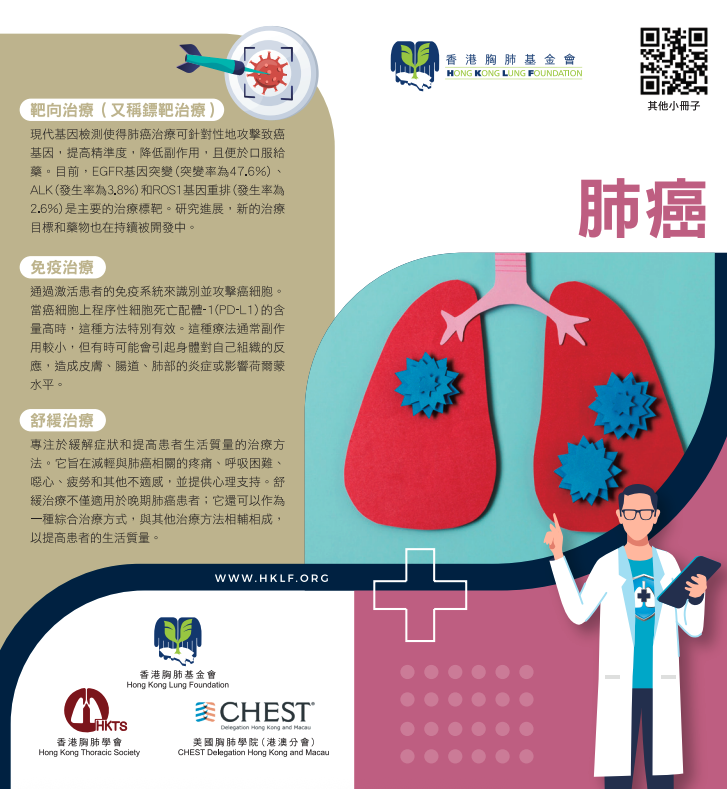
- This treatment is determined based on the genetic testing results of the patient’s cancer cells, such as mutations in genes like EGFR, ALK, ROS-1 and others. If these genetic alterations are detected in the patient, corresponding targeted drugs can be used. Many new drugs are on the pipe line.
Immunotherapy
- Immunotherapy activates the patient’s own immune response to fight cancer cells enabling the T call to recognize and attack cancer cells. This treatment can be used as an adjunct therapy before or after surgery. They could cause unintentional immune reactions to attack normal body parts.
Palliative care
- Palliative care aims to alleviate symptoms such as shortness of breath and pain and improve patient quality of life.
Prognosis of lung cancer
The survival rate for lung cancer is showing an increasing trend with the development of new therapy. It primarily depends on the stage and type of cancer. According to the Cancer Registry statistics, the overall five-year relative survival rate with lung cancer was 21.8%. The five-year relative survival rates were 72.4% at stage I, while stage IV lung cancer had a five-year relative survival rate of 7.8%.
Last updated: March 2026